


















Is a Checkbook IRA Too Good To Be True?
When I first explained the Checkbook IRA to Rick Rule, his private reaction was that it must be illegal. He kept that to himself and, after we got off the phone, checked with his legal counsel. It turns out the structure is genuinely available to U.S. retirement savers.
Most investors save for retirement in a bank deposit or through one of the big financial supermarkets, which offer stocks, bonds, ETFs, mutual funds and maybe annuities. That menu is a business choice made by the firms that hold the accounts, not a limit written into the tax code.
And there are many more alternatives available that you might find attractive.
Federal law allows retirement accounts to own a much wider range of assets — rental real estate, private loans, interests in closely held businesses, crypto — provided the owner follows a clear set of rules about what the account may hold and who may benefit from it.
We speak with people all the time who want to invest in alternative assets. Some are looking at income-producing property. Others have a private investment they find attractive. Some want to reach beyond GLD to hold physical precious metals in their retirement account. And there’s more.
This issue of the Battle Bulletin looks at two tools that give you more control over your investment choices: the Checkbook IRA (CBIRA) and the self-directed Solo 401(k). I’ll cover the legal foundation for each, the assets they can and cannot hold, how they are typically structured, and the practical steps for moving money into them.
As always, this is general education, not tax, legal or investment advice. Anyone considering these structures should work with a qualified tax professional before making any investment.
The Retirement Services Team at Battle Bank can help you understand, establish and maintain your Checkbook IRA or Solo 401(k). If you have questions after reading this Battle Bulletin, contact us at [email protected] and we’ll get in touch.
Why Would I Want To Invest Beyond My Brokerage Account?
Here are reasons why you might venture beyond the standard menu:
- You have a different viewpoint on opportunity than Wall Street. It’s possible that stocks, bonds and mutual funds may be your best choice. This depends on you. But investing can take a lot of forms. There are opportunities that may be driven by different factors, such as local rents, a specific borrower’s repayment or a single company’s growth, and some investors value that difference.
- You want to invest in what you know. A landlord who understands a neighborhood, a business owner who knows an industry or a lender who has worked in real estate may see opportunities that no fund manager will ever offer them.
- You want to change the tax treatment of investments. Rents and interest are often taxed at ordinary income rates when earned in a taxable account. Inside a retirement account, that income can generally be reinvested without current tax, or in a Roth IRA, it may potentially never be taxed at all.
- You want direct control. With a Checkbook IRA or Solo 401(k), the owner chooses the property, borrower or company; sets the terms; and can act quickly when a deal appears.
Some Ideas Worth Exploring
Income-producing real estate. A single-family or vacation rental, a small multifamily building, commercial property, or raw land held for lease can provide rental income and potential appreciation. Later, I’ll show you that all income and expenses must run through the retirement vehicle, and the property must be used only by unrelated parties.
Private equity and startups. A retirement account can invest in an early-stage company (as long as the entrepreneur is not a disqualified person), a private fund or a local business. Because early-stage investments can grow many times over or go to zero, some investors find a Roth IRA a natural home for them since any large gain could come out tax-free.
Hard money and private loans. An IRA can act as the lender on short-term loans, often to real estate investors who need to close or renovate quickly, secured by a recorded mortgage or deed of trust on the property. The IRA earns interest, and if the borrower defaults, the IRA can pursue the collateral. The borrower must be unrelated to the IRA owner.
Notes, trust deeds and tax liens. An IRA can buy existing mortgage notes or participate in tax lien sales, which some investors use as a source of steady, collateral-backed income.
The Other Side of the Ledger
We are a bank, so a couple of disclosures: Opening the door also means seeing what is behind it. Alternative assets are often illiquid, which matters when required minimum distributions begin. They are harder to value. They concentrate risk in a single property, borrower or company. And they demand real due diligence from the owner. Leverage and active businesses can trigger unrelated business income tax. A qualified tax, legal and financial professional should be part of any decision.
Nothing in this section is a recommendation to buy any particular investment. The goal is simply to open the door to ideas that many savers never learn about. You won’t hear this from your broker. Whether any of these options belong in a given retirement plan depends on each person’s goals, experience, time horizon and tolerance for risk.
Now let’s get into the details. Buckle up.
IRA and Roth IRA Basics
The individual retirement account is created by Internal Revenue Code (IRC) Section 408, which sets the requirements for how an IRA is formed, who may serve as trustee or custodian, and how contributions and distributions are taxed. A traditional IRA may allow a tax deduction for contributions, and the account grows tax deferred until withdrawals are taxed as ordinary income. Required minimum distributions generally begin at age 73 under current law.
The Roth IRA, created by IRC Section 408A, reverses the order. Contributions are made with after-tax dollars, and qualified withdrawals, including earnings, are tax-free. Roth IRAs have no required minimum distributions during the original owner’s lifetime, but eligibility to contribute phases out at higher incomes.
For 2026, the IRS has set these limits:
| Item | 2026 Limit |
|---|---|
| IRA contribution (Traditional and Roth combined) | $7,500 |
| IRA catch-up, age 50 and over | $1,100 |
| Roth IRA phase-out, single and head of household | $153,000 to $168,000 |
| Roth IRA phase-out, married filing jointly | $242,000 to $252,000 |
Most IRA owners open their accounts with traditional financial institutions such as brokerage firms, mutual fund companies, banks or insurance companies. These providers typically offer investments like stocks, ETFs, mutual funds, bonds, CDs, money market funds and annuities. While these are all legitimate retirement investments, they generally reflect the types of assets that the institution is equipped to custody and administer. As a result, many custodians limit investors to a narrower range of options than federal tax law allows. In fact, the IRS recognizes that IRA custodians may impose their own investment restrictions, which is why investors seeking greater flexibility often explore self-directed IRA solutions.
| Country | 10-Year Yield, Sept. 2026 |
|---|---|
| USA | 4.96% |
| Japan | 3.00% |
| Germany | 3.51% |
| United Kingdom | 5.36% |
| France | 4.47% |
| Italy | 4.42% |
| Canada | 3.94% |
| Spain | 3.98% |
| Sweden | 3.24% |
| Australia | 5.34% |
The Legal Foundation of the Checkbook IRA
We’re going to go deep on this so you have enough information to start researching how you can best utilize a Checkbook IRA or Solo 401(k).
A Checkbook IRA is not a separate type of retirement account. It is a self-directed IRA governed by the same IRC Section 408 that governs every other IRA. What makes it distinctive is the investment it can hold: a limited liability company (LLC) owned entirely by the IRA and managed by the IRA owner.
The statute does not list approved investments. Instead, it tells us what an IRA may not do, chiefly through three provisions:
- Section 408(a)(3), which bars life insurance contracts;
- Section 408(m), which treats collectibles as distributions; and
- Section 4975, which prohibits certain transactions between the IRA and “disqualified persons,” a group that includes the owner, most family members in the direct line, fiduciaries and entities they control.
Everything not excluded by those rules is, in principle, available. Check with a qualified advisor before making any selection, though.
The Swanson Decision
No court decision “created” the Checkbook IRA, but one case, Swanson v. Commissioner (1996), is widely regarded as the legal foundation for the Checkbook IRA structure. The Tax Court recognized that an IRA may be the original investor in a newly formed entity and own it from inception without creating a prohibited transaction. The court also found that an IRA owner may serve as manager of the entity without automatically engaging in self-dealing. Together, these principles support the modern Checkbook IRA structure, in which a self-directed IRA owns 100% of a special-purpose LLC that provides investment control and checkbook authority while maintaining the IRA’s tax-advantaged status, subject to ongoing compliance with prohibited transaction rules.
IRS Field Service Advice 200128011
IRS Field Service Advice 200128011 (2001) applied the reasoning of Swanson and concluded that IRAs could acquire ownership interests in a newly formed entity without triggering a prohibited transaction. While not binding precedent, the guidance reflects the IRS’s view that IRA ownership of a newly created entity is consistent with the principles underlying today’s Checkbook IRA structure.
Later Cases Draw the Boundaries
Subsequent court decisions have confirmed the validity of the Checkbook IRA structure while defining its limits. In Ellis, compensation paid to an IRA owner by an IRA-owned business was a prohibited transaction. In Peek, personally guaranteeing debt of an IRA-owned entity was prohibited. In McNulty, the court held that although IRAs may own certain precious metals, the metals must be held by a qualified custodian or approved depository. Personal possession by the IRA owner was treated as a taxable distribution.
Together, these cases reinforce that the structure itself is permissible, but IRA owners must maintain a strict separation between personal activities and IRA assets to preserve the IRA’s tax-advantaged status.
What an IRA Can and Cannot Own
The Internal Revenue Code generally allows an IRA to invest in any asset unless specifically prohibited. Under IRC Section 408, the primary prohibited investments are life insurance contracts and most collectibles, including artwork, antiques, rugs, gems, stamps, alcoholic beverages, and most coins and precious metals.
An exception under IRC Section 408(m)(3) permits certain U.S.-minted gold, silver and platinum coins, as well as qualifying bullion, provided the metals are held by a bank or IRS-approved nonbank trustee.
Additionally, IRC Section 4975 prohibits transactions that directly or indirectly benefit the IRA owner or other disqualified persons.
Finally, under IRC Section 1361, an IRA cannot be an S corporation shareholder, a position affirmed in Taproot Administrative Services v. Commissioner, 133 T.C. 202 (2009).
Within these limitations, a self-directed IRA may generally invest in a broad range of alternative assets, including residential and commercial real estate, raw land, rental properties, private loans and promissory notes, private equity and startup investments, LLC and partnership interests, tax liens and trust deeds, qualifying precious metals, and certain digital assets, in addition to traditional investments such as stocks, bonds, mutual funds and ETFs.
Does the IRS Issue Rulings on Eligible Assets?
The IRS does not publish a list of approved investments and does not pre-approve specific ones. Its retirement plans FAQs state plainly that the law does not permit IRA funds to be invested in life insurance or collectibles, that the IRS does not prohibit real estate, and that trustees and custodians remain responsible for what they accept. Guidance on individual situations comes mainly through Chief Counsel memoranda such as FSA 200128011, private letter rulings issued to specific taxpayers (which cannot be relied on by anyone else), and IRS Publications 590-A and 590-B. The IRS has also used notices to address newer assets: In Notice 2023-27, it said it intends to treat a non-fungible token (NFT) as a collectible when the right or asset the NFT represents is itself a collectible, such as a digital certificate of ownership for a gem or a work of art. The Department of Labor also has interpretive authority over the prohibited transaction rules and issues advisory opinions and exemptions in that area.
Nuances That Trip People Up
The common thread is that IRA assets must be kept separate from personal use. The IRA owner and certain family members cannot personally benefit from, use or transact with IRA-owned assets.
Situation | Permitted | Not Permitted |
|---|---|---|
Real Estate Use | The IRA LLC purchases investment real estate and leases it to unrelated third parties. | The IRA owner, spouse, parents, grandparents, children or grandchildren use, occupy or benefit from the property, even temporarily. |
Property Services | The IRA LLC hires and pays independent third-party contractors to perform repairs, maintenance or improvements. | The IRA owner personally performs repairs, renovations, maintenance, landscaping or other services for the property. |
Paying Expenses | All property expenses are paid directly from the IRA LLC’s bank account. | The IRA owner pays expenses personally and later seeks reimbursement from the IRA or LLC. |
Lending Activities | The IRA makes loans to unrelated individuals or entities on arm’s-length terms. | The IRA makes loans to, or receives loans from, the IRA owner, their spouse, lineal family or another disqualified person. |
Buying and Selling Assets | The IRA buys from and sells to unrelated parties at fair market value. | The IRA purchases the IRA owner’s own property. The IRA buys property from a disqualified person. |
Financing | The IRA or LLC obtains financing that does not require a personal guarantee by the IRA owner. | The IRA owner personally guarantees a loan or otherwise extends personal credit to the IRA-owned investment (Peek v. Commissioner). |
Precious Metals | IRA-owned precious metals are held by a qualified custodian or approved depository. | IRA-owned coins or bullion are held personally by the IRA owner (McNulty v. Commissioner). |
While siblings are not considered disqualified persons under IRS rules, any transaction involving family members should be reviewed carefully. Certain investments, such as leveraged real estate or an LLC that operates an active business, can create taxable income inside an IRA. If that occurs, the IRA may be required to file IRS Form 990-T and pay taxes on that income.
How a Checkbook IRA Is Structured
A Checkbook IRA has four layers, each with a distinct role:
- The account owner. Establishes a self-directed IRA and directs its investments.
- The self-directed IRA. This is held by a qualified custodian, which keeps the account records, handles IRS reporting and holds title to the IRA’s assets.
- The IRA-owned LLC. This is a special-purpose LLC owned 100% by the IRA. The custodian invests IRA cash in the LLC in exchange for its membership interest, and the account owner is typically named manager in the operating agreement.
- The LLC bank account and investments. The LLC opens its own business checking account, and the manager writes checks or otherwise makes payments from it to make investments directly: closing on a property, funding a note or subscribing to a private offering.
The advantage of a Checkbook IRA is the combination of control, flexibility and speed. The owner does not need the custodian to review and sign every transaction, which can be especially important when a real estate transaction is closing on short notice or an investment generates frequent activity.
The Trade-Off Is Responsibility
With the Checkbook IRA comes the obligation to ensure every transaction complies with IRS rules, keep LLC funds separate from personal funds, title assets in the LLC’s name, and maintain records needed for the custodian to report the IRA’s annual fair market value. While a single-member LLC owned by an IRA is generally treated as a disregarded entity for federal income tax purposes and does not file a separate income tax return, the account owner remains responsible for maintaining proper records and ensuring ongoing compliance.
The Self-Directed Solo 401(k)
Who Qualifies
The IRS describes the one-participant 401(k) as a plan covering “a business owner with no employees, or that person and his or her spouse.” The business can be a sole proprietorship, partnership, LLC or corporation, and it can be a side business alongside a W-2 job. The plan remains a solo plan only while there are no eligible common-law employees other than the owner and spouse. Employees who have not met the plan’s age and service requirements can generally be excluded, but under SECURE 2.0, long-term part-time workers who log at least 500 hours in two consecutive years must be allowed to make deferrals. Once eligible employees must be covered, nondiscrimination testing applies and the plan is no longer a true solo plan.
Who Can Contribute What
The owner contributes in two roles. As the employee, the owner can defer up to 100% of compensation up to the annual deferral limit, on a pretax or Roth basis if the plan allows. As the employer, the business can add a nonelective contribution of up to 25% of compensation. For self-employed owners, the employer piece is calculated on net earnings after the self-employment tax deduction, which works out to roughly 20% of net profit; IRS Publication 560 has the worksheets.
|
2026 Limit |
Amount |
|---|---|
|
Employee deferral |
$24,500 |
|
Catch-up, age 50 and over |
$8,000 |
|
Higher catch-up, ages 60 to 63 |
$11,250 |
|
Total employee plus employer (excluding catch-up) |
$72,000 |
|
Maximum compensation considered |
$360,000 |
A spouse who earns compensation from the business can make their own deferrals and receive employer contributions, which can roughly double a household’s annual savings capacity. Two cautions apply. The employee deferral limit is per person across every 401(k) and 403(b) plan the individual participates in, so a W-2 employee who already defers at a day job has less room in the solo plan. And once plan assets reach $250,000 at year-end, the plan must file Form 5500-EZ annually.
Rollovers Into a Solo 401(k)
If the plan document permits, a Solo 401(k) can generally accept rollovers from pretax traditional IRAs, SEP IRAs, SIMPLE IRAs (after the two-year period), and former employer 401(k), 403(b) and governmental 457(b) plans. Direct rollovers are preferred to avoid mandatory withholding and the 60-day deadline. Roth IRA money cannot be rolled into a 401(k), although Roth 401(k) balances from another plan can usually be moved by direct rollover.
Are the Investment Rules the Same as a CBIRA?
Largely, yes. The Section 4975 prohibited transaction rules and the Section 408(m) collectibles rule apply to self-directed 401(k) accounts just as they do to IRAs, so the table of nuances above applies here too. The differences are structural and, for many investors, favorable:
- No custodian or LLC required. The owner can serve as trustee of the plan’s trust and open accounts directly in the trust’s name, which provides checkbook control without a separate LLC layer.
- Participant loans. The plan may lend a participant the lesser of $50,000 or 50% of the vested balance under IRC Section 72(p). An IRA can never lend to its owner.
- Leveraged real estate. Qualified plans can often use qualifying non-recourse acquisition debt on real estate without triggering unrelated debt-financed income under IRC Section 514(c)(9), an exemption IRAs do not have.
- More administration. The owner, as trustee, is responsible for determining valuations and Form 5500-EZ filings.
Practical Matters
Moving an IRA From Schwab, Fidelity or Another Brokerage
Yes, an existing IRA at a brokerage can be moved into a Checkbook IRA. Most brokerage firms will not retitle stocks, mutual funds, ETFs or other securities directly into an IRA-owned LLC, so those positions are typically sold inside the existing IRA first. The cash proceeds then move to the new self-directed IRA custodian through a trustee-to-trustee transfer. The usual sequence is:
- Open the self-directed IRA with the new custodian.
- Form the LLC, with an operating agreement naming the IRA as sole member, and obtain its EIN.
- Submit the transfer request through the receiving custodian, which contacts the brokerage.
- Liquidate positions inside the old IRA so no taxable event occurs.
- Once the cash arrives, the custodian invests it in the LLC, and the LLC opens its bank account.
A direct trustee-to-trustee transfer is not a distribution and is not subject to the once-per-12-month limit that applies to 60-day IRA-to-IRA rollovers, so it is almost always the better path.
Transferring an Existing Checkbook IRA to Battle Bank
Owners who already have a Checkbook IRA elsewhere can generally transfer it to Battle Bank through a trustee-to-trustee transfer while keeping the existing LLC and its underlying investments in place. Rather than selling assets, the prior custodian assigns the IRA’s LLC membership interest to Battle Bank as the new custodian for the owner’s benefit, and the LLC’s operating agreement is updated to reflect the new member of record. The LLC’s bank account, properties, notes and other holdings generally stay where they are. Owners should be prepared to provide the operating agreement, the LLC’s formation documents and EIN, and a current fair market value for the LLC. This approach minimizes disruption and avoids the cost and delay of liquidating or retitling assets.
Rolling an Employer Plan Into a Checkbook IRA
Money in many former employer plans, including 401(k), 403(b), 457 and pension plans, can generally be rolled into a Checkbook IRA once the owner is eligible to take a distribution from the plan. Direct rollovers are preferred because the funds move straight from plan to IRA without the 20% mandatory withholding that applies when a check is paid to the participant. Active employees may face restrictions on moving money out of a current employer’s plan, and eligibility ultimately depends on that plan’s rules, so it is worth checking with the plan administrator before starting.
There are a number of providers out there, but I want to highlight how we open Checkbook IRAs at Battle Bank. Battle Bank provides custody and administrative support, while the IRA owner directs the investments as LLC manager and remains responsible for compliance with IRS rules.
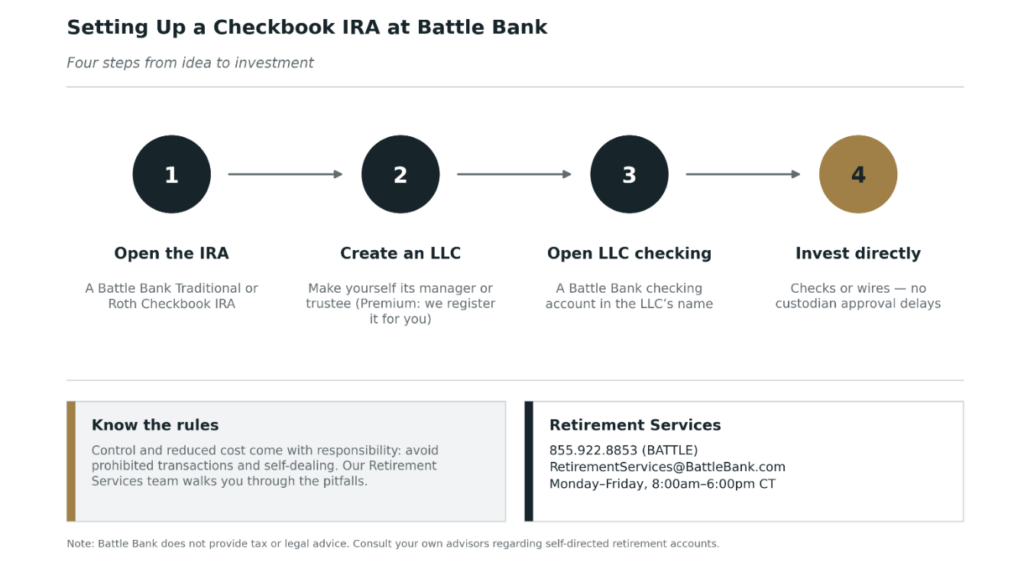
Battle Bank’s Role | What Battle Bank Does |
|---|---|
IRA custody | Establishes and maintains the self-directed IRA |
LLC setup | Helps you form the special-purpose LLC owned by the IRA |
Banking | Opens the dedicated LLC checking account |
Funding support | Assists with IRA transfers and eligible plan rollovers |
Administration | Processes and reports IRA transactions |
Annual reporting | Completes required IRA tax and fair market value reporting |
Ongoing support | Supports annual LLC compliance and account maintenance |
Solo 401(k)
Battle Bank’s Role | What Battle Bank Does |
|---|---|
Plan documents | Establishes and maintains the Solo 401(k) plan documents |
Banking | Opens and maintains a dedicated Solo 401(k) checking account |
Depository services | Holds the plan’s cash assets in the trust checking account |
Ongoing maintenance | Provides required updates to the plan documents |
Account Holder’s Role | What the Account Holder Does |
|---|---|
Plan administration | Serves as the plan administrator and trustee |
Investment control | Directs and executes the plan’s investments |
Recordkeeping | Maintains records of contributions, rollovers, investments, expenses, and distributions |
Compliance | Ensures transactions comply with the plan documents and IRS rules |
This Battle Bulletin was written by Battle Bank team members with a little help from Claude.
